Finding a job in Isoko is not impossible. It is just different from how job hunting works in Warri, Asaba or Lagos, and most people go about it the wrong way. This guide explains how the Isoko job market actually works, who the real employers are, and where openings are announced.
Quick Answer
Most jobs in Isoko North and Isoko South come from five places: the oil and gas fields spread across communities like Uzere, Olomoro, Oleh and Ozoro, Southern Delta University in Ozoro, state government recruitment through bodies like SUBEB and PPEB, the two local government secretariats, and private businesses including schools, clinics, shops and farms.
Only a small share of these jobs are ever advertised online. The rest are filled through word of mouth. So the winning strategy is to watch online sources for the big formal recruitments while building local contacts for everything else.
Understanding the Isoko Job Market
Isoko is a region in Delta State, in the Niger Delta area of southern Nigeria. It is made up of two local government areas. Isoko North has its headquarters in Ozoro, and Isoko South has its headquarters in Oleh. Together they cover nineteen clans, including Uzere, Ozoro, Owhe, Iyede, Emede, Igbide, Emevor, Ofagbe, Ellu, Oyede, Irri, Aviara, Olomoro, Enwhe, Okpolo and Oleh.
Traditionally, the Isoko economy has been built on farming, fishing, and the production of palm oil and palm kernels. That is still true for many families today. But sitting on top of that farming economy is one of the oldest oil producing zones in Nigeria, and that changes the employment picture in ways many job seekers do not fully take advantage of.
Here is the honest part. Isoko does not have the volume of advertised office jobs that Warri or Asaba has. If you sit at home refreshing job websites and filtering for Isoko, you will see very little. That does not mean there are no jobs. It means most of them never reach the internet.
The Five Main Sources of Jobs in Isoko
1. Oil and Gas
Isoko is one of the earliest oil producing areas in the country. The first oil well in Delta State was drilled at Uzere in 1959, and another followed at Olomoro in 1962. Today the region hosts around seventeen listed oil and gas fields, spread across communities such as Uzere, Oleh, Olomoro, Emede, Owhe, Igbide, Okpolo-Enwhe, Ozoro, Ellu and Ofagbe.
Uzere alone has two fields, Uzere West and Uzere East, holding around 43 wells that produce in the region of 53,000 barrels per day. Several operators work across these assets, including the Nigerian Petroleum Development Company, Heritage Oil and First Hydrocarbon. The Olomoro-Oleh and Uzere fields fall under OML 30, which is operated by Shoreline Natural Resources and includes producing flow stations and gas compression facilities in the area.
Now the important detail for job seekers. The big operators rarely hire directly from the community for junior roles. Most of the hiring happens through servicing contractors, catering firms, security companies, logistics providers and maintenance outfits working on those sites. Those are the doors that actually open. Community liaison offices and host community committees are also worth knowing, because local content agreements often require that a share of jobs go to indigenes.
2. Southern Delta University, Ozoro
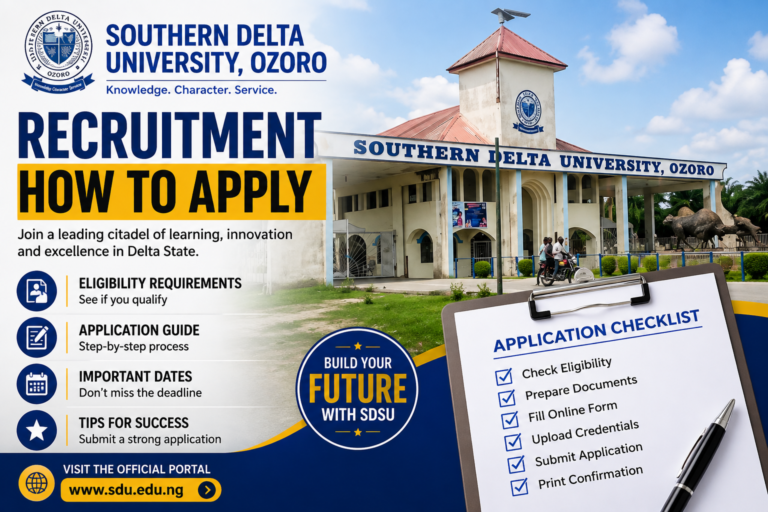
This is the single biggest formal employer inside Isoko. The institution started life as Delta State Polytechnic, Ozoro, was upgraded by an act of the Delta State House of Assembly in February 2021, and has since been known as Delta State University of Science and Technology and as Southern Delta University. If you are searching for its vacancies online, try all three names, because different job sites still use different versions.
The university sits in Ozoro in Isoko North, roughly 95 kilometres from Warri and about 115 kilometres from Asaba, and it runs a second campus at Orerokpe. It recruits in batches rather than continuously, and a single recruitment round can carry dozens of positions at once. These are not only lecturing roles. Batches usually include registry staff, bursary staff, library staff, technologists, drivers, security personnel and administrative officers.
Applications are normally addressed to the Registrar, and the university publishes advertisements in newspapers and on Nigerian job portals. Because recruitment comes in waves, the practical advice is to keep your credentials assembled and ready so you can move quickly when a round opens.
3. Delta State Government Recruitment
State level recruitment is where the largest single batches of jobs appear, and teaching is the biggest category. The Delta State Government approved the recruitment of 2,000 teachers to be handled through the Post Primary Education Board and the State Universal Basic Education Board. Applicants generally need an NCE, a B.Ed or an equivalent teaching qualification, and the process runs through screening, computer based testing and interviews.
Teacher recruitment applications are submitted through the state portal at jobs.deltastatemobse.net. Beyond teaching, the Delta State Civil Service Commission handles recruitment into ministries and departments, and health sector openings come through the Ministry of Health.
One rule to memorise. No genuine government recruitment in Nigeria asks you to pay money at any stage. Not for a form, not for shortlisting, not for screening. Anyone requesting payment is running a scam.
4. Local Government and Community Institutions
The Isoko North secretariat in Ozoro and the Isoko South secretariat in Oleh both employ staff directly, and they also announce openings for contract and casual roles that never appear online. The same goes for primary health centres, public and private secondary schools, and the primary schools spread across the thirteen wards of Isoko North and the wards of Isoko South.
These roles are usually announced on notice boards, in churches, at community meetings and through the town unions. If you are serious about working locally, physically visiting these places once a month will do more for you than a hundred online applications.
5. Private Business, Trade and Agriculture
Uzere serves as a major trading centre where surrounding towns bring farm produce to sell, and the markets in Ozoro, Oleh and Irri support a steady flow of small business activity. Shops, pharmacies, filling stations, block industries, poultry and fish farms, transport businesses, hotels and private schools all hire regularly.
These jobs pay less than oil sector work, but they are far easier to enter, and many people use them as a stepping stone while waiting for something bigger.
Looking Just Outside Isoko
If you are willing to travel or relocate, the towns around Isoko widen your options considerably.
| Location | What is there |
|---|---|
| Ughelli | Manufacturing, including rubber processing, plus banking and retail |
| Warri | The commercial centre of Delta State, strongest for oil servicing and corporate roles |
| Asaba | State capital, strongest for government, media and administrative roles |
| Kwale | Gas and industrial activity |
Warri is roughly 95 kilometres from Ozoro and Asaba about 115 kilometres, so both are realistic for someone willing to commute weekly or relocate.
Where to Actually Find Openings
Online
- This website, isokoJOBs.com, where we collect verified openings for Isoko and its surrounding areas
- General Nigerian job boards filtered to Delta State, such as MyJobMag, HotNigerianJobs, Jobzilla and Indeed Nigeria
- The Delta State Government website and the teacher recruitment portal
- Southern Delta University announcements, searched under all three of its former and current names
Offline
- Notice boards at the two local government secretariats
- Church announcements, which remain one of the most effective channels in Isoko communities
- Town union and clan meetings, especially for oil sector openings tied to host community agreements
- WhatsApp groups for Isoko graduates and indigenes
- Walking into businesses directly and asking, which still works better here than most people expect
Getting Yourself Ready
Opportunities in Isoko often come with short notice. A recruitment window may open and close within two weeks. So preparation matters more than searching.
Keep scanned copies of your certificates, NYSC discharge certificate or exemption letter, birth certificate or declaration of age, local government identification, and passport photographs saved on your phone and in your email. Keep a clean one page or two page CV updated. Make sure you have a working email address that you actually check, and a phone number that stays reachable.
Local government identification deserves special mention. Many state and community roles give preference to indigenes, and being able to produce that document quickly puts you ahead of applicants who cannot.
Avoiding Job Scams
Fake job adverts are common, and oil producing areas attract more of them than most places because people are desperate for those roles. Watch for these warning signs.
- Any request for payment, whether it is called a form fee, screening fee, medical fee or processing fee
- Offers of oil company jobs with unusually high salaries and no interview process
- Messages from personal phone numbers or free email addresses claiming to represent a major company
- Pressure to respond immediately or lose the opportunity
- A request for your bank details or BVN before any interview has taken place
When you are unsure, take the company name and search it separately. If it is a real recruitment, you will usually find it published somewhere official.
Frequently Asked Questions
Are there really jobs available in Isoko?
Yes, but most are not advertised online. Oil servicing contractors, schools, the local government secretariats, private businesses and Southern Delta University all hire. The difficulty is visibility, not the absence of jobs.
Which town in Isoko has the most job opportunities?
Ozoro, because it hosts Southern Delta University and the Isoko North secretariat. Oleh follows as the Isoko South headquarters, and Uzere is significant for both oil activity and trading.
Do I need to be an Isoko indigene to get a job there?
Not for private sector roles. But state government recruitment often gives preference to Delta State indigenes, and host community agreements in the oil sector are usually structured to favour people from the affected communities.
How do I get an oil company job in Isoko?
For entry level positions, target the servicing contractors rather than the operators themselves. Register with your community liaison committee, and consider technical training such as welding, fitting, instrumentation, safety certification or heavy equipment operation, since these skills are consistently in demand on the fields.
Can I serve my NYSC year in Isoko?
Yes. Corps members posted to Delta State report to the orientation camp at Issele-Uku in Aniocha North, roughly thirty minutes from Asaba, and are then assigned to places of primary assignment across the state, including schools and offices in Isoko North and Isoko South.
Final Word from us
The people who find work in Isoko are usually not the ones with the best certificates. They are the ones who are prepared, visible and connected. Keep your documents ready, stay in touch with your community networks, and check verified listings regularly.
We update isokoJOBs.com with openings for Isoko and its surrounding areas. Check the listings page regularly, and if you are an employer in Isoko, you can post a vacancy on the site at no cost.